4% Paraformaldehyde in PBS (1 L)
FIXATIVE · TISSUE PRESERVATION · IMMUNOHISTOCHEMISTRY · ELECTRON MICROSCOPY
Overview
Preparation of 1 litre of 4% (w/v) paraformaldehyde (PFA) fixative buffered in 1× PBS at pH 7.45. PFA is sparingly soluble at room temperature; dissolving requires heating to 60 °C under a fume hood and transient alkalisation with NaOH to break the polymer chains. Final pH is adjusted back to 7.45 with HCl. The finished solution is suitable for perfusion fixation, immersion fixation, and pre-fixation prior to EM processing.
Safety
Hazard Warning — Fume Hood Mandatory
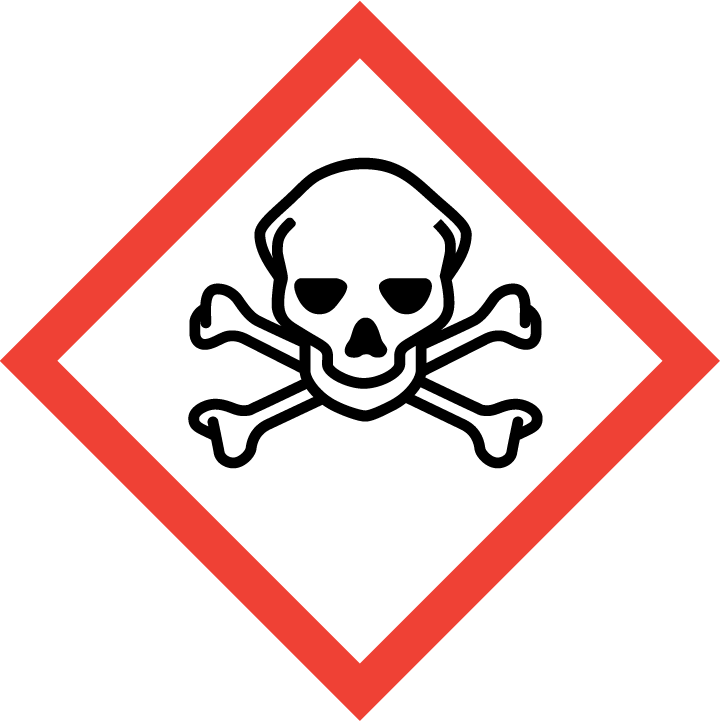 GHS06
GHS06TOXIC
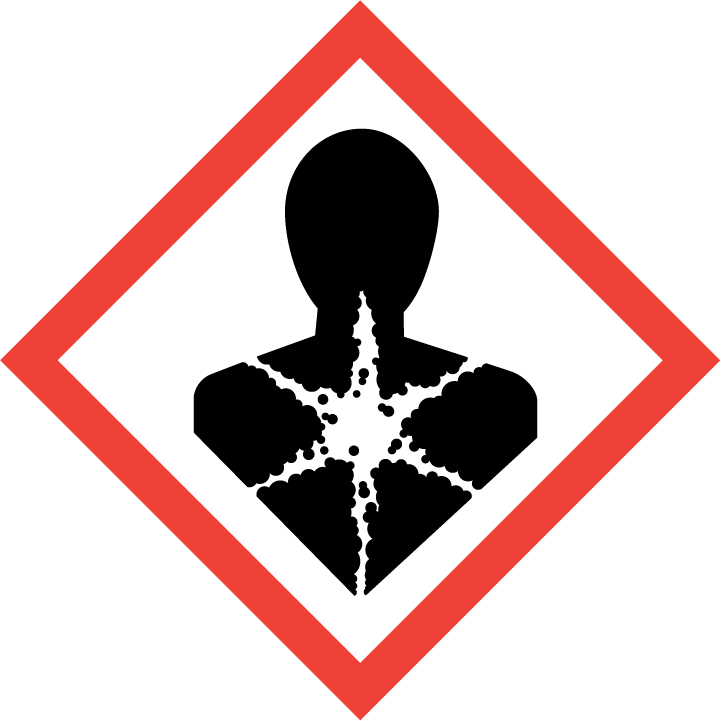 GHS08
GHS08HEALTH
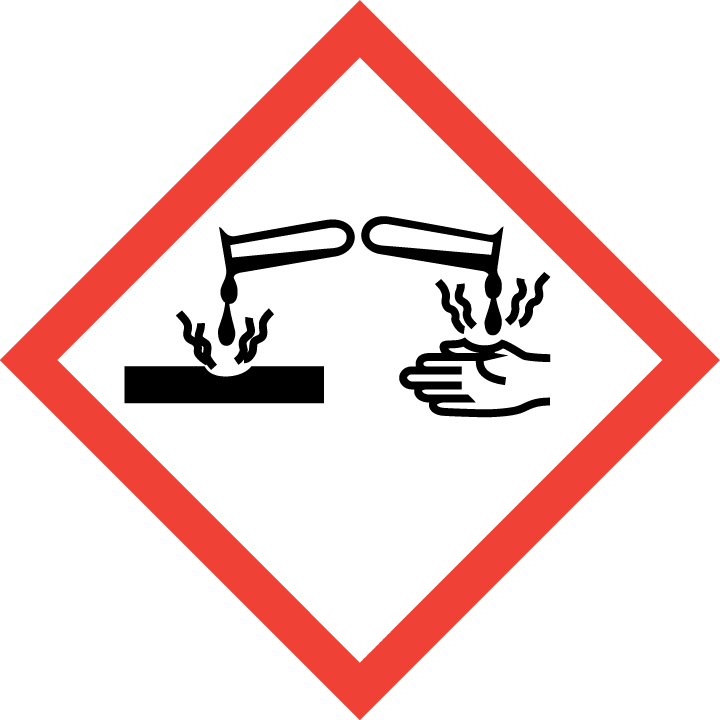 GHS05
GHS05CORROSIVE
 GHS07
GHS07IRRITANT
- PFA is a potential human carcinogen and fixative — all handling strictly under fume hood.
- Wear nitrile gloves, lab coat, safety goggles, and an FFP2/N95 respirator when weighing PFA powder.
- PFA powder is a respiratory and skin sensitiser — avoid inhalation of dust entirely.
- NaOH and HCl are corrosive — use caution during pH adjustment; add drop by drop.
- Do not exceed 60 °C — higher temperatures accelerate formalin vapour release and depolymerisation artefacts.
- Dispose of waste PFA solution as aldehyde-containing chemical waste according to institutional guidelines.
- In case of skin contact: rinse immediately with large amounts of water for ≥ 15 min.
Reagents & Equipment
| # | Reagent / Item | CAS | Amount (1 L) | Final conc. | Supplier | Hazard |
|---|---|---|---|---|---|---|
| 01 | Paraformaldehyde (PFA) powder | 30525-89-4 | 40.0 g | 4% w/v | Sigma-Aldrich | GHS06GHS08 |
| 02 | PBS (10×), sterile | — | 100 mL | 1× (diluted) | In-house | — |
| 03 | dH₂O (distilled water) | 7732-18-5 | ad 1 000 mL | — | In-house | — |
| 04 | NaOH solution (1 N) | 1310-73-2 | few drops | pH adjustment ↑ | In-house | GHS05 |
| 05 | HCl solution (1 N) | 7647-01-0 | few drops | pH adjustment ↓ | In-house | GHS05GHS07 |
| E1 | Glass beaker 1 000–1 500 mL | — | 1 × | — | Lab stock | — |
| E2 | Magnetic stirrer / hot plate | — | 1 × | 60 °C | Lab stock | — |
| E3 | pH meter (calibrated) | — | 1 × | target: 7.45 | Lab stock | — |
| E4 | 0.45 µm syringe filter or filter paper | — | 1 × | — | Lab stock | — |
Protocol Steps
| # | Action | Time |
|---|---|---|
| 01 |
FUME HOOD Switch on the fume hood and confirm airflow. Put on full PPE: nitrile gloves, lab coat, safety goggles, FFP2 respirator.
All subsequent steps must be performed inside the fume hood.
|
— |
| 02 |
Add 100 mL of 10× PBS to a 1 L glass beaker. Top up with ~700 mL dH₂O and place a magnetic stir bar inside.
Do not fill to 1 L yet — volume is adjusted in the last step.
|
— |
| 03 |
60 °C Place the beaker on the hot plate/stirrer inside the fume hood. Heat to 60 °C while stirring. Monitor temperature continuously.
Do not exceed 60 °C — formaldehyde vapour increases significantly above this temperature.
|
~10 min |
| 04 |
FUME HOOD Slowly and carefully weigh out 40.0 g PFA powder. Add the powder in small portions to the warm PBS/dH₂O while stirring. Keep the sash as low as possible while weighing.
PFA is sparingly soluble — solution will appear cloudy/milky at this stage. This is expected.
|
~5 min |
| 05 |
pH ↑ Add 1 N NaOH drop by drop (typically 5–15 drops) while stirring until the solution clears completely. The pH will rise to ~11–12 — this is intentional and necessary to depolymerise PFA.
Alkalisation breaks the formaldehyde polymer chains. The solution transitions from opaque white to clear within a few drops. Stop adding NaOH once clear.
|
~5 min |
| 06 |
Continue stirring at 60 °C until the solution is fully clear with no visible particles. Maintain temperature.
|
~5–10 min |
| 07 |
Remove the beaker from heat and allow to cool to ~40–45 °C while still stirring.
pH adjustment is more accurate and reproducible at lower temperature. Cooling also reduces formalin vapour pressure.
|
~10 min |
| 08 |
pH ↓ Add 1 N HCl drop by drop while stirring. Monitor pH with a calibrated pH meter. Bring pH down to exactly 7.45.
Add HCl slowly — the pH drops quickly near neutral. Overshoot below pH 7.0 and the solution may re-precipitate; if so, add 1–2 drops NaOH to correct.
|
~5–10 min |
| 09 |
CHECK Confirm final pH = 7.45 with the calibrated pH meter. Adjust with a single drop of 1 N NaOH or 1 N HCl if needed and recheck.
|
— |
| 10 |
Top up the solution to 1 000 mL with dH₂O. Recheck pH — it should remain at 7.45.
Diluting with a small volume of water will minimally shift pH. If needed, make one final micro-adjustment.
|
— |
| 11 |
Filter the solution through a 0.45 µm filter or folded filter paper into a clean labelled glass bottle. The solution should be clear and colourless.
|
~5 min |
| 12 |
Label the bottle: 4% PFA in PBS · pH 7.45 · Date · Initials. Aliquot into working volumes (e.g. 50 mL Falcon tubes). Store at 4 °C (up to 1 month) or −20 °C for long-term storage.
Do not store at room temperature. Discard any aliquot that appears cloudy, has precipitate, or smells strongly of formaldehyde.
|
— |
Notes & Observations
Why NaOH first, then HCl? PFA powder is a polymer (polyformal) that dissolves very poorly in aqueous solution at neutral pH. Raising the pH to ~11–12 with NaOH depolymerises the chains to produce monomeric formaldehyde in solution (paraformaldehyde → HCHO). Once clear, HCl is used to bring the pH back to the physiological target of 7.45, which is optimal for tissue preservation without osmotic damage.
Temperature note: Heating to 60 °C accelerates dissolution but PFA begins to decompose above ~70 °C. Never boil. If a hot plate without temperature read-out is used, test with a thermometer probe first.
Freshness matters: 4% PFA works best when freshly prepared. For the most sensitive immunofluorescence applications, prepare on the day of use. Frozen aliquots (−20 °C) thawed once retain fixation quality for up to 6 months.
Temperature note: Heating to 60 °C accelerates dissolution but PFA begins to decompose above ~70 °C. Never boil. If a hot plate without temperature read-out is used, test with a thermometer probe first.
Freshness matters: 4% PFA works best when freshly prepared. For the most sensitive immunofluorescence applications, prepare on the day of use. Frozen aliquots (−20 °C) thawed once retain fixation quality for up to 6 months.